
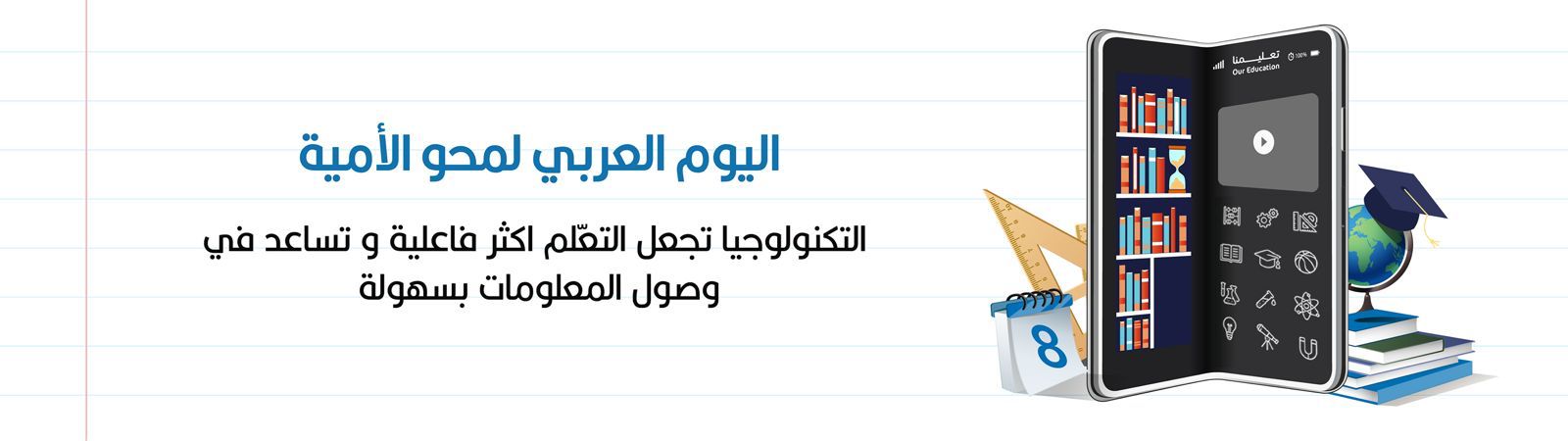
Technology has contributed to the literacy scene through various software and tools, providing educational resources online through free educational content, which has contributed to solving problems related to financial inability, which is one of the most powerful crises that stand between a person and education.
Smartphone and tablet applications have also provided many simplified educational methods, whether through pictures and illustrations, or through fun educational games that have enhanced the educational process, not to mention their availability at all times and quickly, which has enhanced the individual’s ability not to allocate specific places for studying.
Through the Internet and using artificial intelligence, it was possible to customize scientific curricula and periodically follow up for each individual individually according to their level of comprehension, and to qualify the illiterate to learn in the best appropriate ways, and according to their mental level.
Countries use technology to fight illiteracy
In turn, many countries around the world have used technology and its various tools in education, and one example is India, which has provided programs and systems through which it can reach illiterate people in all places, which has enabled it to determine the numbers of illiterate people and their locations. This data has helped to enable the raising of literacy rates in India during the thirty-eight years ending in 2018, from 41% to 74%.
For its part, Egypt also developed educational curricula for the elderly, especially girls, due to the difficulty of teaching these groups in many rural areas, by presenting educational lessons in the form of games, songs and cartoons, in which the capabilities of modern digital technology helped, which ultimately led to reducing the teaching period for educational curricula to a third of the time allocated, reaching three months.
The Kingdom plays a leading role in the illiteracy file
In this regard, Saudi Arabia, represented by the Ministry of Education, has taken upon itself a pioneering role in eradicating illiteracy , not only for the Kingdom, but for the Arab nation through the Arab Decade for Literacy Initiative 2015-2024, where the number of illiterate Arabs over the age of 15 is 70 million, representing 9.1% of the total number of illiterate people in the world.
Individually, the Kingdom has also been able to reduce its illiteracy rate from 5.6% to 3.7%, providing more than 1.3 thousand training programs, which benefited more than 90 thousand citizens, while Saudi Arabia aims to completely eradicate illiteracy by 2030, through several development programs targeting the illiterate.
our education Investment Company always seeks to provide all digital technological solutions that help different educational systems facilitate the educational process for providers and recipients of educational services of all kinds.